
The building industry has spent the last two decades tightening envelopes, cutting carbon, and squeezing more performance from every system. The next shift is less about machinery and more about the people inside. Health is becoming a design input, not a side effect, and policy is where that change will either scale or stall.
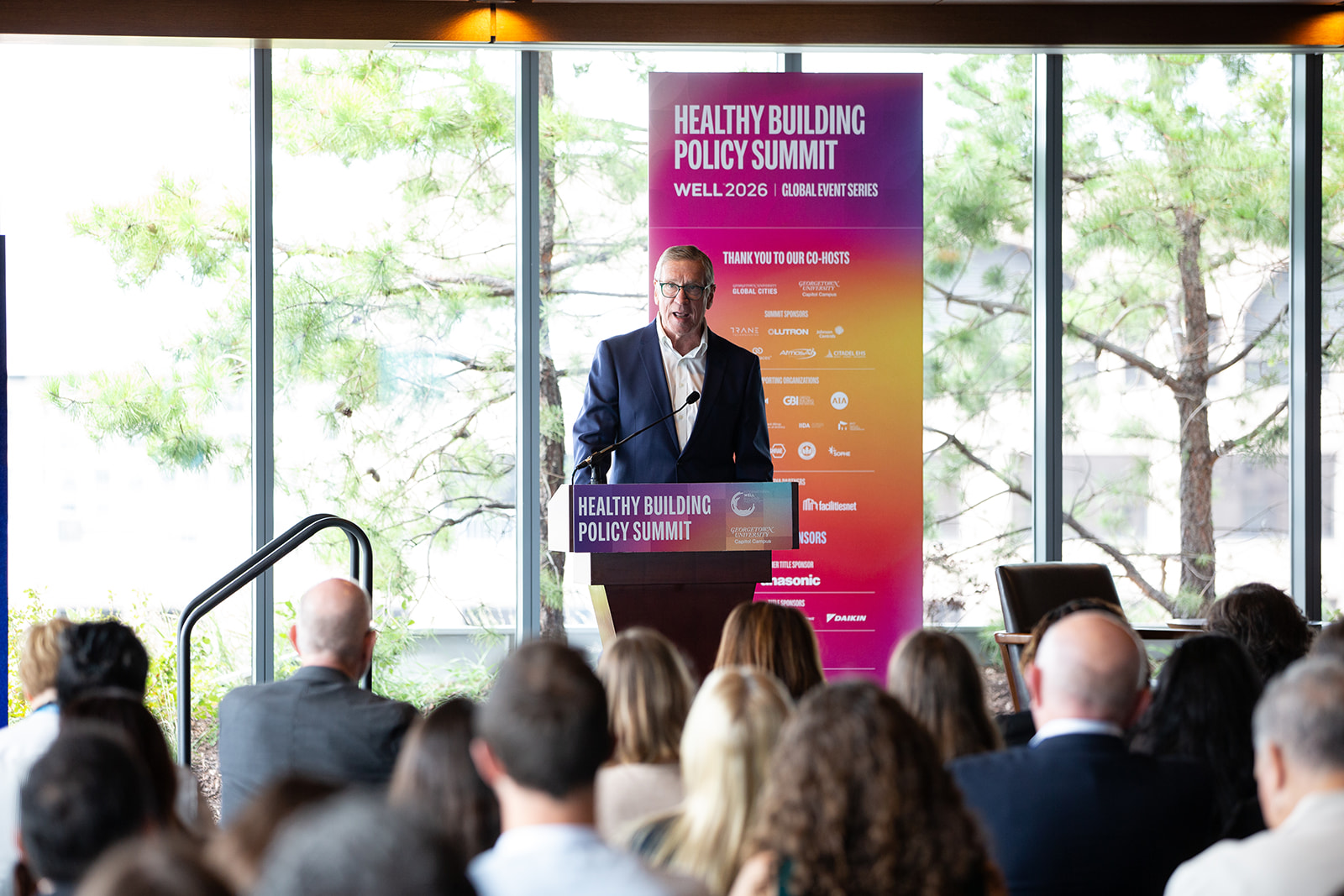
That was the framing at the International WELL Building Institute’s third annual Healthy Building Policy Summit, held at Georgetown University’s McCourt School of Public Policy on its Capitol Campus in Washington, D.C. The event brought together policymakers, public health researchers, building professionals, and business leaders to discuss how buildings can become stronger assets for health, economic performance, and community resilience.
BEE was represented by Stephanie Beaumont, Americas Director, who attended as a delegate.
From Science to Standards
In the opening plenary, Dr. Joseph Allen of the Harvard T.H. Chan School of Public Health explored how buildings influence human health and productivity, and where policy needs to go next. IWBI President and CEO Rachel Hodgdon set the tone for the day: «We are entering a new era for healthy buildings, defined not only by what the science tells us, but by what the market demands and what communities increasingly expect.»
The summit focused on practical policy levers: indoor air quality standards, the evidence-based return on investment of healthy buildings, access to healthy environments, and the role of cities and states in driving market transformation. A recurring theme was the connection between building health and broader national concerns, including biosecurity, community resilience, and economic performance.
Why Engineers Belong in the Conversation
For BEE, the value is in the overlap between engineering and health. WELL and similar frameworks give project teams a common language, but the work still has to be delivered through mechanical design, materials selection, commissioning, and operations. As policy begins to codify some of those requirements, the engineers who implement them need a seat at the table.
«It was fantastic to attend the Healthy Building Policy Summit and to hear from such a diverse range of speakers united in their vision of how buildings may increase performance for health and community resilience,» said Stephanie Beaumont, Americas Director at BEE.
The Shift in the Room
The summit reinforced the connection between healthy buildings and the way cities, employers, and institutions approach risk, public health, and long-term performance. For building owners and developers, the priority is shifting from selecting a standard to understanding what a building needs to deliver for the people inside it.
That question sits at the center of BEE’s work.