
I spent two days this June at the 2026 Hong Kong International Nature-based Solutions (NbS) Action Week, and I came away with one idea I keep returning to: a green space can look full of life and still be ecologically empty.
That gap matters for anyone thinking about biodiversity in green building. Nature-based solutions are moving quickly in Hong Kong, through new government design guidance, a maturing financing conversation, and real projects on the ground.
The harder question is whether a planted wall, a green roof, or a landscaped podium is doing ecological work, or just looking the part.
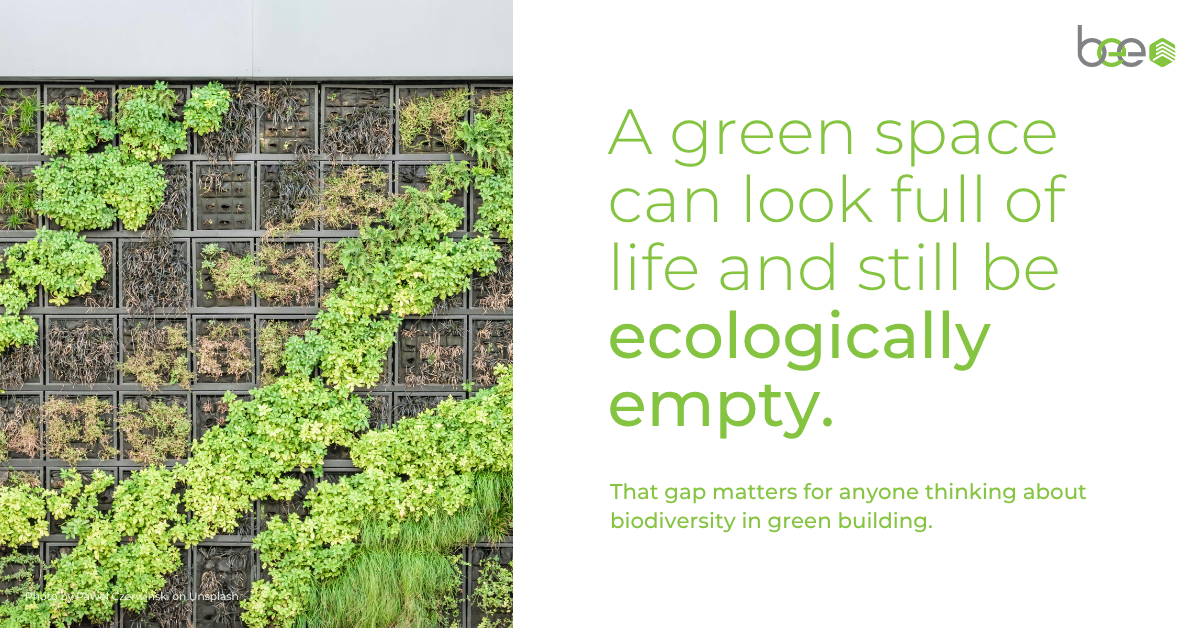
Branded quote graphic carrying the line “A green space can look full of life and still be ecologically empty,” beside a living wall. Published on bee-inc.com.
The Action Week ran from 1 to 5 June at the Hopewell Hotel, drawing more than 200 people to its open sessions. It was co-organised by Civic Exchange, The Nature Conservancy (TNC), and the International Union for Conservation of Nature (IUCN), with sponsorship from The Robert H.N. Ho Family Foundation Hong Kong.
The rooms were full of people from policy, finance, academia, and practice, and the framing shifted depending on who held the microphone.
Two ways to value nature, two days apart
One thing stuck with me. Across the two days, «putting a value on nature» was discussed in almost opposite registers. The first day looked at nature-based solutions through implementation: nature as the source of ecosystem services that keep cities habitable, where assigning a dollar figure almost feels like a category error.
The second day looked at financing, where a credible monetary value is the thing that unlocks capital. Both views are defensible. I would have liked to watch the two sides actually debate each other, because that tension is where most real projects live.
It connects directly to certification. LEED and BEAM Plus both ask projects to address biodiversity; in LEED’s case, roughly a tenth of the rating now sits under that heading.
But the Action Week made the implementation gap plain, on the technical side (what actually counts as ecological function) and the financial side (who pays for it, and how it is valued).
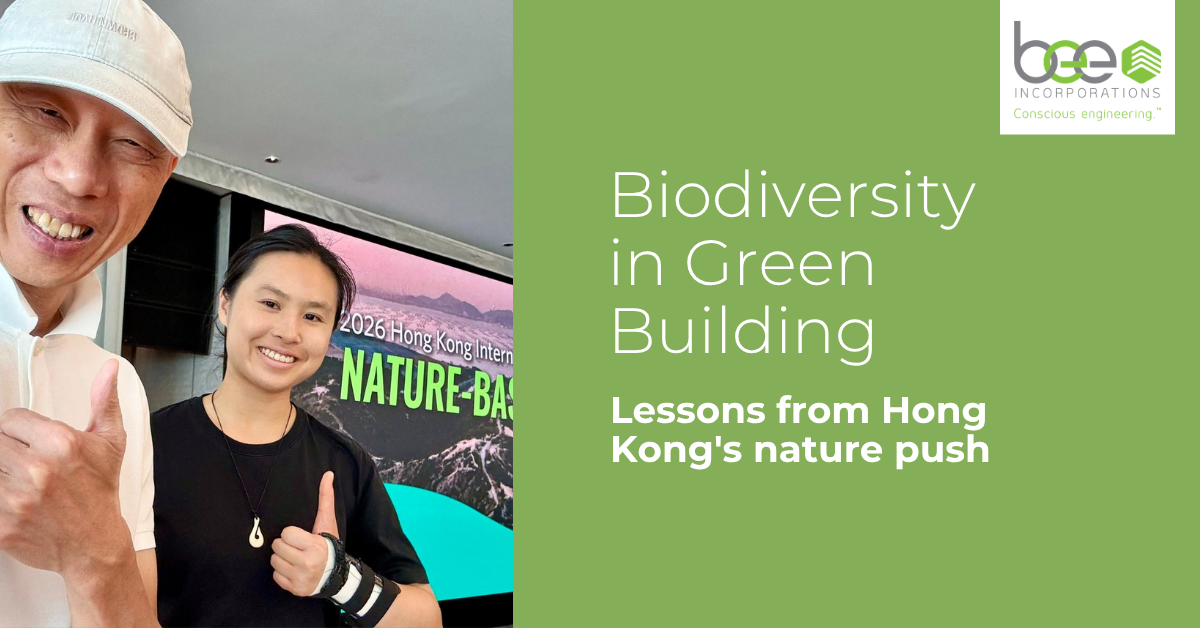
Featured banner for the article “Biodiversity in green building: lessons from Hong Kong's nature push.” Shows Wong Kam Sing, Hong Kong's former Secretary for the Environment (left), with Jade Wong at the 2026 Hong Kong International Nature-based Solutions Action Week. Published on bee-inc.com.
Where biophilic and biodiverse part ways
This is the same distinction our Founder and President, Alessandro Bisagni, raised when he facilitated a ULI Minds session on nature-positive real estate in Shanghai a few weeks earlier:
”“Biophilic design does not equal biodiversity. A green wall with five species is biophilic but ecologically dead. A real biodiversity strategy uses native, climate-appropriate species that support complex food webs and ecological function.”
Alessandro BisagniFounder and President, BEE Incorporations
Three points from the Hong Kong sessions sharpened that for me.
First, biophilic spaces do real climate work.
They shade hard surfaces, slow weathering and erosion, and sustain the pollinators our food and ecological systems depend on. Those are measurable services, not decoration.
Second, they have to be designed for the local climate.
Native plants need less artificial irrigation and slot into existing ecosystems.
One of the clearer interventions in the new Hong Kong Nature-based Solutions Design Guidelines is to reforest the city’s green belts with native trees rather than cheaper imported species.
Trees suited to the local climate make ecosystems more resilient and hold soil in place.
Third, and this is the one project teams underestimate: you cannot maintain a living system the way you maintain a building.
Biophilia keeps growing, responding, and sometimes failing.
Studies shared during the week pointed to community ownership as a quiet driver of success. When people feel responsible for a space, it copes better with stressors like rising heat.
This is why the updated Hong Kong Biodiversity Strategy and Action Plan (BSAP), launched at the end of 2025, sets out four strategic areas: nature conservation, deepening mainstreaming, capacity building, and collaborative partnering. The framework encourages biophilic design and nature-based solutions that are tailored to ever-evolving ecosystems, responding to change with the support of multi-sector collaboration.
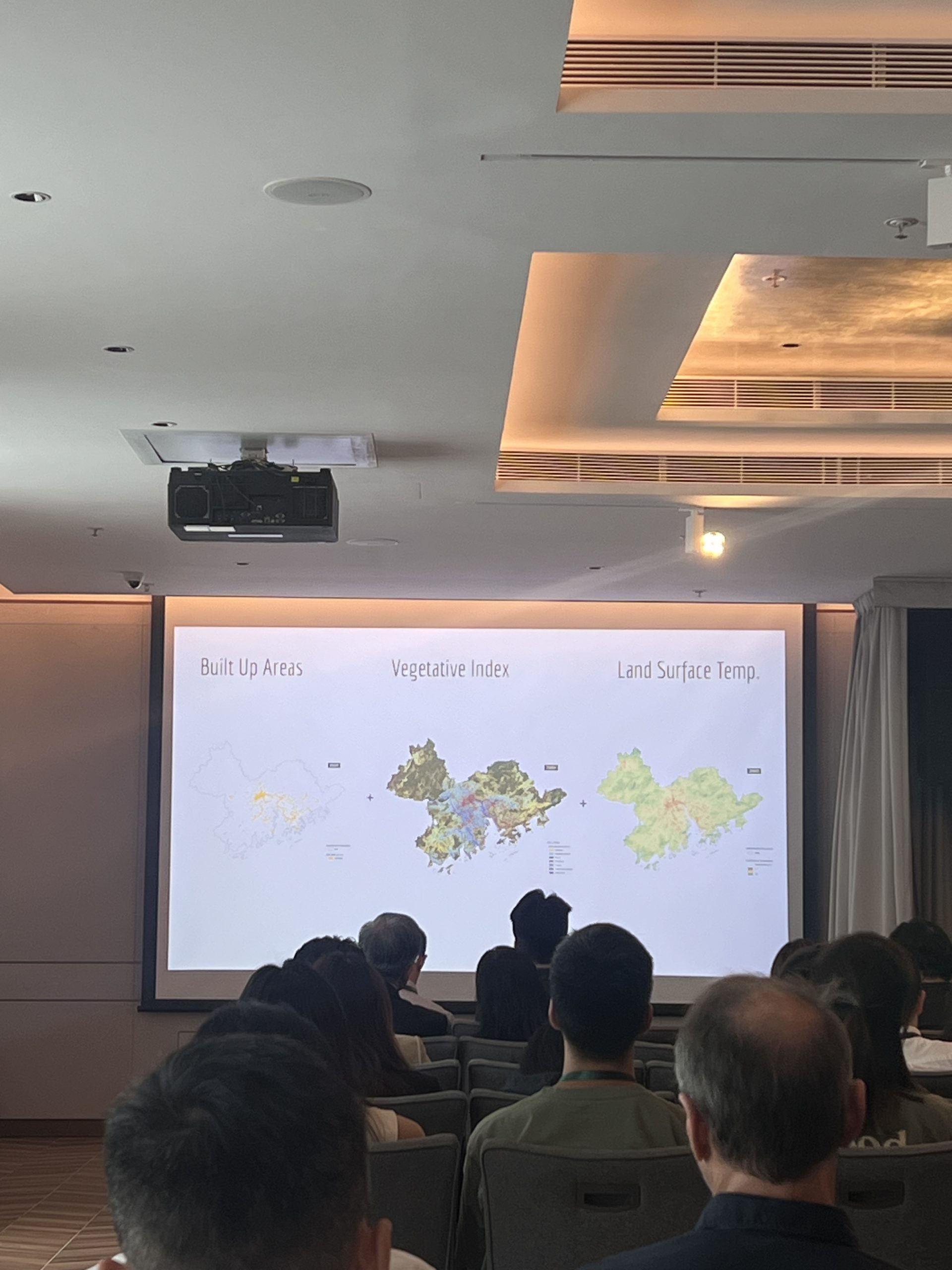
Built-up areas, vegetative index, and land surface temperature across Hong Kong.
The money problem nobody has solved
The financing day put a number on the challenge. Roughly US$200 billion flows into nature globally each year, and about 90% of it is public money, according to the UN Environment Programme’s State of Finance for Nature work.
The investment needed to close the global biodiversity financing gap is far larger, an estimated US$598–824 billion a year (Deutz et al., 2020). Closing the gap means private capital, and private capital wants a value it can underwrite, which loops straight back to the valuation debate from day one.
Alessandro has hit the same wall: there is still very little solid literature on how to value green infrastructure, a gap that also surfaced at a livable cities conference I presented at in Manchester.
I also had the chance to talk with Wong Kam Sing, Hong Kong’s former Secretary for the Environment, whose work on countryside and rural revitalisation draws a line between environmental and cultural sustainability. His point, that vernacular architecture and traditional ways of living are a source of design ideas and not just heritage, stayed with me.
What this means for a project team
If you coordinate projects, the takeaway is practical. A biodiversity credit on a scorecard is not the same as a biodiverse ecosystem that provides benifits year-round.
A biodiverse ecosystem contains more species that can survive and thrive in different environmental conditions, thereby increasing resilience of green spaces even when facing various extreme weather events. Specifying native, climate-appropriate planting further ensures resilience by making sure green spaces are well integrated into the local climate and ecosystem
Project teams should also consider planning for living maintenance, not just installation. Bring the people who will use and tend the space into the design early.
At BEE, that thinking shows up in our retrofit work; the Prince Building podium conversion in Central is one current example where existing structure and greenery are being rethought rather than removed.
About the organisers
Civic Exchange is an independent Hong Kong public policy think tank focused on a more livable, sustainable city, and has ranked among the world’s top environmental policy think tanks since 2011.
The Nature Conservancy (TNC) is a global conservation organisation working across more than 80 countries, with over 30 years in the Asia Pacific.
The International Union for Conservation of Nature (IUCN) is a global union of government and civil society members and the body behind the IUCN Global Standard for Nature-based Solutions, which the Hong Kong guidelines draw on.
About the Hong Kong Nature-based Solutions Design Guidelines
The Hong Kong Nature-based Solutions Design Guidelines (HKNbSDG) were jointly launched in March 2026 by the Civil Engineering and Development Department (CEDD) and the Agriculture, Fisheries and Conservation Department (AFCD).
They set out three core principles, ecosystem diversity at multiple scales, human-nature coexistence, and resilience through NbS, and are intended as practical guidance for infrastructure and development projects, including the Northern Metropolis.
I left encouraged. More projects are taking nature-based solutions and social factors seriously as a response to climate risk. But intention still runs ahead of implementation, and the funding and policy support have not caught up.
”“There is still a notable gap between intention and implementation. I'm eager to work with industry collaborators and clients to explore options for upscaling sustainable initiatives in Hong Kong and beyond.”
Jade WongSustainability Project Engineer, BEE Incorporations
That is the work worth doing next.
About BEE Incorporations — Founded in 2009 by Alessandro Bisagni, BEE Incorporations is a global green building consultancy headquartered in Hong Kong and Shanghai. The firm operates 15 offices across four continents, specialising in green building certifications (LEED, WELL, RESET, BEAM Plus), ESG advisory, performance testing, and the BEE Sense IAQ and energy monitoring platform.
Special thanks to JC-Ray H. Bellen, Marketing and Communications Associate, BEE Incorporations, for their editorial review and suggestions on this piece.